


Building Sustainable Ministries in the Digital Age
Part 1 of 4: Faith – The Foundation of Sustainable Gospel Music Ministry

Executive Summary
The modern Gospel music landscape provides unprecedented opportunities for independent artists, ministries, churches, podcasters, and faith-based content creators to reach audiences worldwide. Digital distribution, streaming platforms, social media, podcasting, and direct-to-fan communication have dramatically lowered barriers to entry while simultaneously increasing competition for attention.
Many discussions surrounding Gospel music growth focus primarily on marketing tactics, social media strategies, streaming numbers, and promotional campaigns. While these elements play an important role in audience development, sustainable ministry requires a deeper foundation.
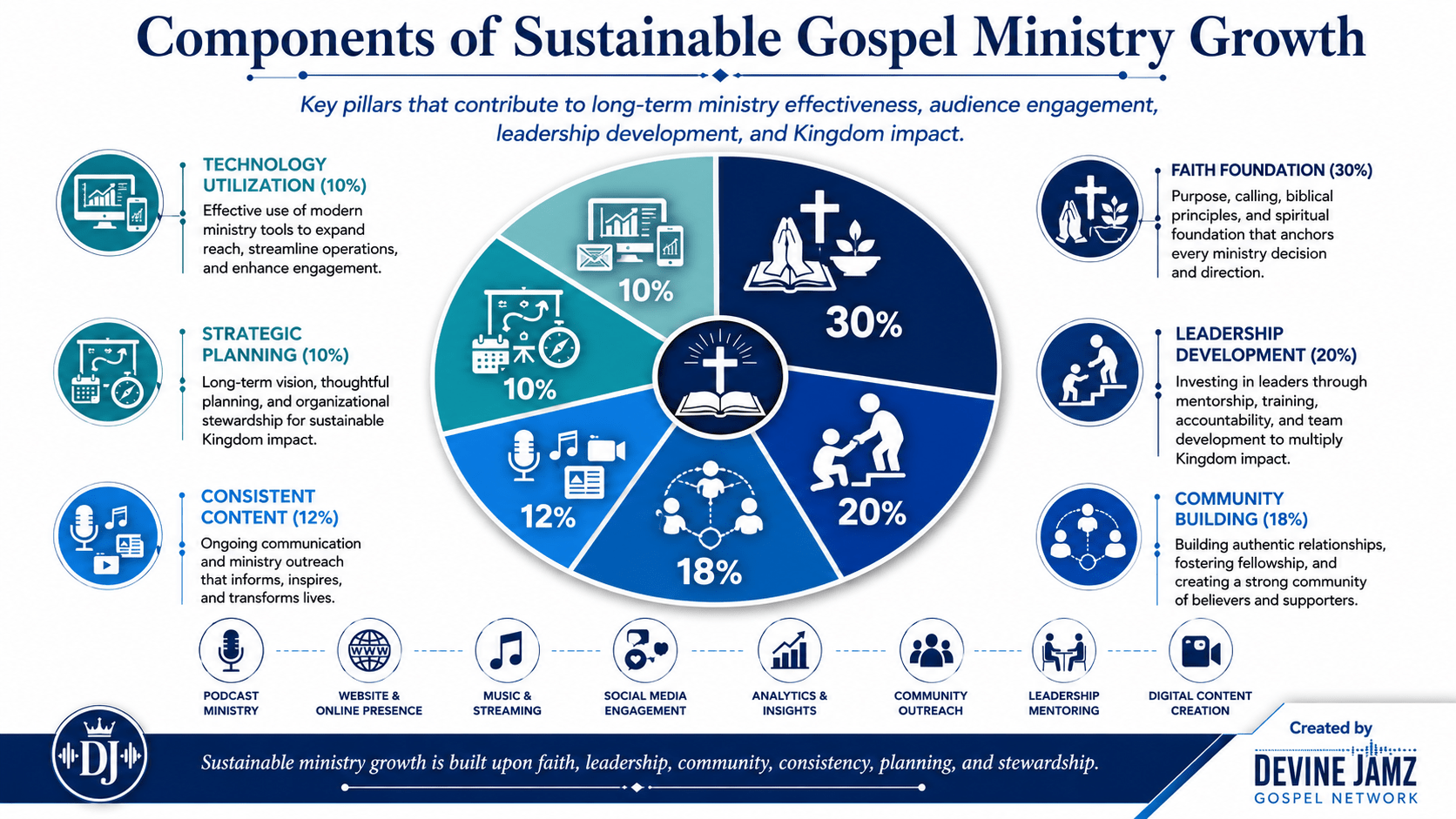
This white paper argues that faith remains the most important component of long-term Gospel music ministry success. Faith shapes vision. Vision influences leadership. Leadership develops infrastructure. Infrastructure creates impact. Impact ultimately produces legacy.
Without a strong foundation, growth may occur temporarily, but sustainability becomes difficult. Through research, industry observations, and ministry leadership principles, this publication introduces a framework designed to help Gospel music ministries build lasting Kingdom impact in an increasingly complex digital environment.
Introduction
The digital revolution has transformed how music is created, distributed, discovered, and consumed. Independent Gospel artists now possess tools that previous generations could only imagine. Music can be distributed globally within days. Podcasts can reach listeners around the world. Video content can be published instantly. Websites can serve as ministry hubs operating twenty-four hours a day.
These opportunities have created tremendous possibilities for Gospel ministry.
However, technology has also created significant challenges.
Artists and ministries often find themselves competing within crowded digital environments where thousands of songs, videos, podcasts, and social media posts are published daily. Algorithms determine visibility. Trends shift rapidly. Audience attention becomes fragmented across multiple platforms.
As a result, many ministry leaders find themselves asking tactical questions:
- How do I gain more listeners?
- Which platform should I prioritize?
- How often should I post content?
- How can I increase engagement?
While these questions are important, they should not precede foundational questions:
- Why does this ministry exist?
- Who are we called to serve?
- What message are we stewarding?
- How should Kingdom impact be measured?
The answers to these questions determine whether a ministry becomes sustainable or simply becomes another participant in the attention economy.
For additional perspective on ministry ecosystems and long-term audience development, consider linking internally to:
Building a Kingdom-Centered Independent Music Marketing Ecosystem
Devine Jamz Gospel Network: Building a Kingdom-Centered Independent Music Marketing Ecosystem
The Current State of Independent Gospel Music Ministry
Today’s Gospel music ministries operate in an environment characterized by both extraordinary opportunity and unprecedented competition.
Digital distribution has democratized access to audiences. Independent artists no longer require major label representation to release music globally. Websites, podcasts, social media platforms, and email marketing systems provide direct communication channels that allow ministries to develop relationships with supporters.
Yet the same technologies that create opportunity also create challenges.
Content Saturation
The volume of content available today continues to grow at remarkable rates. Music, videos, podcasts, blogs, and social media posts compete simultaneously for audience attention.
Audience Fragmentation
Listeners consume content across multiple platforms. They may discover music through streaming services, engage on social media, watch videos on YouTube, listen to podcasts, and subscribe to email newsletters.
Limited Resources
Many independent Gospel ministries operate with limited budgets, volunteer teams, competing work responsibilities, and family obligations.
Time Constraints
Balancing ministry responsibilities with personal commitments requires intentional stewardship and leadership.
Technology Changes
Platforms evolve constantly. Algorithms change. New communication tools emerge while older methods lose effectiveness.
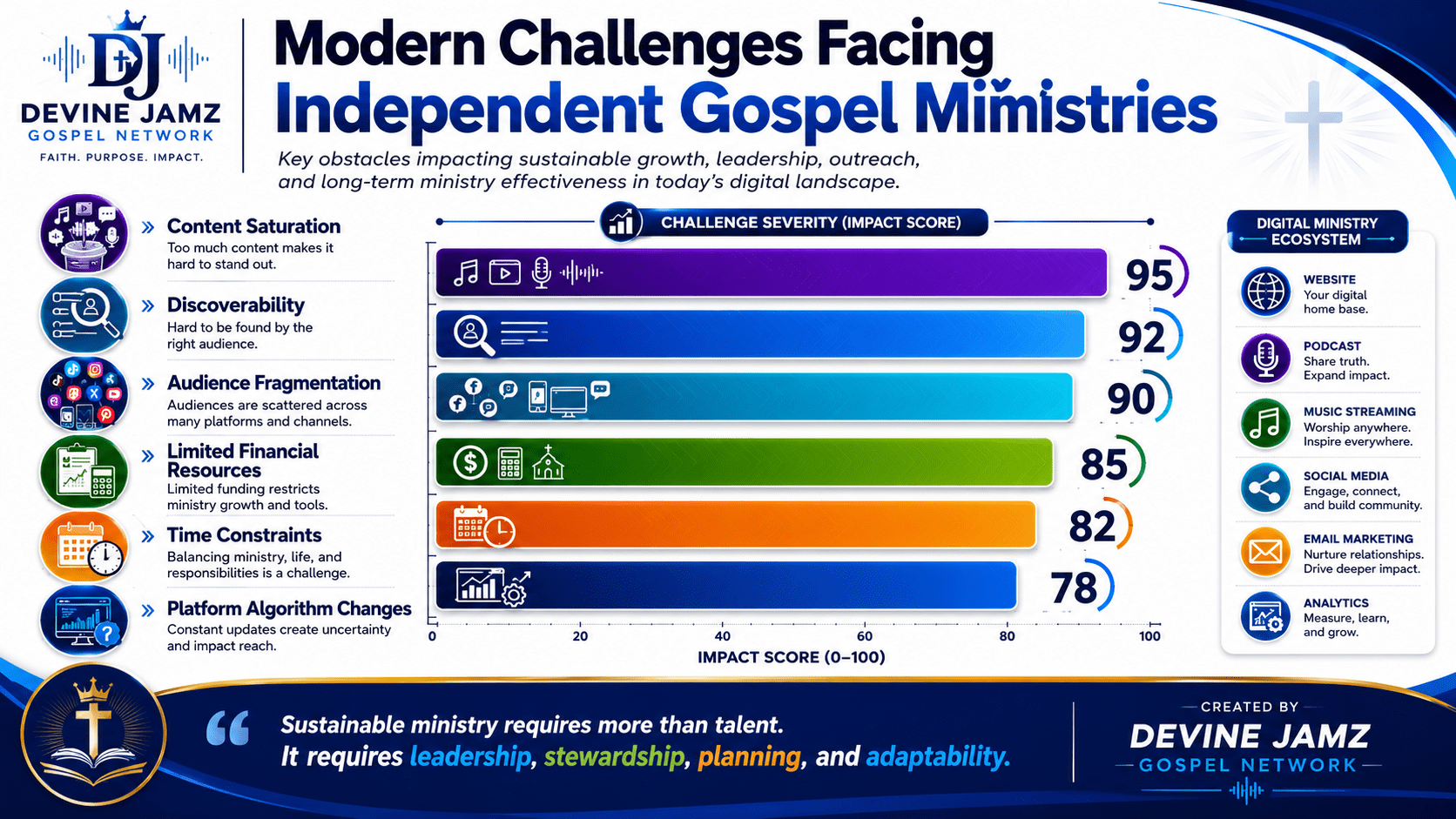
The purpose of identifying these challenges is not to discourage ministry leaders. Rather, it is to recognize the realities that sustainable ministries must navigate successfully.
For additional context, consider linking internally to:
The Economics of Digital Streaming and the Gospel Artist Survival Shift
Economics of Digital Streaming and the Gospel Artist Survival Shift
Ministry Is More Than Music
Music remains one of the most powerful communication tools available to ministries. Songs inspire, encourage, teach, and unite communities.
However, sustainable ministry extends beyond music itself.
Ministry involves:
- Relationships
- Stewardship
- Leadership
- Service
- Community
- Impact
A song may capture attention, but meaningful ministry develops through ongoing engagement and authentic connection.
Many artists mistakenly evaluate success solely through:
- Streams
- Followers
- Views
- Likes
- Playlist placements
While these metrics can provide useful insights, they do not fully measure Kingdom impact.
True ministry success often includes outcomes that are more difficult to quantify:
- Encouragement
- Transformation
- Hope
- Community
- Spiritual growth
- Relationship building
This distinction separates ministry from entertainment.
A ministry leader views audiences as people rather than metrics.
For additional perspective:
Why Christian Gospel Music Continues to Move Hearts Across Generations
Why Christian Gospel Music Continues to Move Hearts in a Way No Other Genre Can
Why Faith Must Precede Vision
Organizations often begin with strategic planning.
Faith-based ministries begin with purpose.
Faith provides the foundation upon which vision is built.
Without faith:
- Vision becomes self-centered.
- Growth becomes the objective.
- Opportunities become distractions.
- Metrics become identity.
Faith establishes priorities and values. It influences decision-making during both seasons of growth and seasons of challenge.
Faith-centered leadership recognizes that:
- Platforms may change.
- Technology will evolve.
- Trends will come and go.
- Audience behavior will shift.
Faith provides consistency amidst constant change.
This is why sustainable Gospel music ministry begins with faith rather than tactics.
The Kingdom Leadership Framework
Faith
↓
Vision
↓
Leadership
↓
Infrastructure
↓
Impact
↓
Legacy
This framework serves as the foundation for the entire white paper series.
Faith-Based Leadership in a Digital World
Modern ministry leaders face pressures that previous generations rarely encountered.
Social media often rewards comparison.
Digital culture encourages instant gratification.
Audience expectations continue to evolve.
Faith-centered leadership requires the discipline to remain focused on purpose rather than popularity.
Leaders must learn to:
- Think long-term
- Prioritize stewardship
- Build healthy teams
- Develop future leaders
- Maintain integrity
The most sustainable ministries are rarely built by individuals working alone.
They are built by leaders who develop systems, cultivate relationships, and empower others.

Faith-based leadership is not simply about managing projects.
It is about guiding people toward a shared mission while maintaining alignment with Kingdom values.
For additional reading:
A Continuing Case Study in Faith-Based Media, Marketing & Independent Artist Development
Advanced Insights in Music Marketing: A Continuing Case Study
Building a Ministry That Can Outlast a Song Release
Many artists focus heavily on the next release.
Sustainable ministries focus on building systems that continue serving audiences long after a release campaign ends.
These systems often include:
- Websites
- Email communication
- Podcasting
- Blogging
- Community engagement
- Leadership development
- Documentation
- Strategic planning
Ministries that invest in infrastructure create opportunities for long-term influence.
This principle aligns with one of the recurring themes throughout Devine Jamz Gospel Network’s research:
Sustainable ministry growth is built through consistent stewardship rather than isolated promotional events.
For additional study:
- Ultimate Gospel Artist Blueprint Part 1
- Ultimate Gospel Artist Blueprint Part 2
- Ultimate Gospel Artist Blueprint Part 3
Conclusion
The digital age presents remarkable opportunities for Gospel music ministries.
However, sustainable ministry requires more than technology, marketing, or visibility.
Faith remains the foundation.
Faith shapes vision.
Vision guides leadership.
Leadership develops infrastructure.
Infrastructure creates impact.
Impact ultimately produces legacy.
When ministries build upon this foundation, they position themselves to serve audiences effectively while creating long-term Kingdom influence that extends beyond a single song, campaign, or season.
Coming Next
Part 2 of 4
Leadership: Moving Beyond the Artist Mindset
External References
- Pew Research Center
- Edison Research
- IFPI
- YouTube Creator Academy
- Spotify
- Meta
- Music Business Worldwide
- Deloitte Insights
- McKinsey & Company Insights
Suggested Scripture References
- Proverbs 3:5–6
- Matthew 6:33
- Colossians 3:23
- Ephesians 4:11–13
- 1 Peter 4:10
Disclaimer & Transparency Notice
This publication may contain affiliate links. Devine Jamz Gospel Network may earn a commission if you purchase products or services through links referenced in this publication at no additional cost to you.
This publication was created with the assistance of Artificial Intelligence (AI) technology. While reasonable efforts have been made to review and edit the content, AI-generated information may contain inaccuracies, omissions, outdated information, or interpretations that are not entirely accurate. Readers are encouraged to independently verify all facts, statistics, references, research findings, and claims before making decisions based upon this content.
The views and opinions expressed are solely those of Devine Jamz Gospel Network and are provided for educational, informational, and research purposes only.
Related Posts:
 Faith, Leadership, and Legacy in Gospel Music Ministry | Part 2
  Advanced Insights in Music Marketing: A Continuing Case Study Devine Jamz Music Marketing Case Study Devine Jamz Gospel Network: Building a Kingdom-Centered Independent Music Marketing Ecosystem Ultimate Gospel Artist Blueprint: Organic Growth, Branding & Digital Marketing Success | Part 2 of 3 Ultimate Gospel Artist Blueprint: Organic Growth, Branding & Digital Marketing Success | Part 1 of 3 Ultimate Gospel Artist Blueprint: Organic Growth, Branding & Digital Marketing Success | Part 3 of 3 General FAQ